
The History of the Flippable Mattress
Ask someone who purchased a mattress several decades ago about mattress care and you’ll likely hear the same advice:
“Rotate it. Flip it. Take care of it.”
For generations, flippable mattresses were the industry standard. Consumers understood that periodically turning and rotating a mattress helped preserve comfort and extend longevity.
Today, however, many consumers are surprised to learn that most mattresses can no longer be flipped at all.
What changed?
And more importantly, was the change actually an improvement?
The answers reveal a fascinating story about craftsmanship, manufacturing, and the evolution of the modern mattress industry.
If you're weighing your options today, our one-sided vs. two-sided mattress comparison breaks down the tradeoffs.
When Flippable Mattresses Were the Standard
For much of the twentieth century, virtually every quality mattress was designed with two sleeping surfaces.
This approach was not considered a luxury feature.
It was simply good mattress design.
Manufacturers understood that distributing wear evenly across both sides would:
-
Extend lifespan
-
Preserve comfort
-
Reduce body impressions
-
Improve long-term performance
The philosophy was simple:
Build a mattress designed to last.
Why Mattresses Were Built Differently
Earlier mattress makers viewed durability as one of the primary measures of quality.
Consumers expected mattresses to serve them for many years.
To achieve this, manufacturers relied on:
-
Two-sided construction
-
Natural materials
-
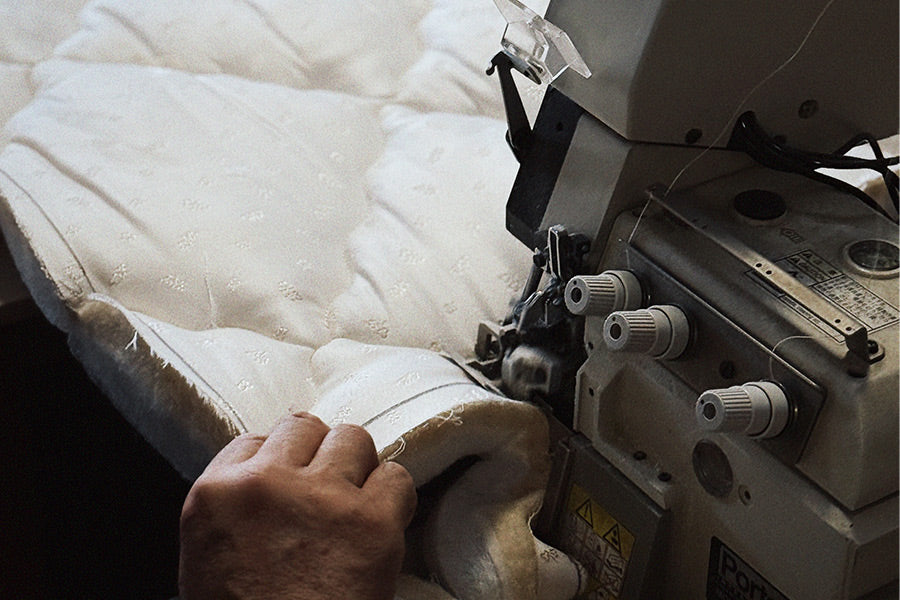
Hand tufting
-
Reinforced support systems
-
Skilled craftsmanship
These techniques helped create products capable of maintaining comfort and support over extended periods.
The Rise of One-Sided Mattresses
Beginning in the late twentieth century, the industry gradually shifted toward one-sided mattress construction.
Several factors contributed to this change.
Manufacturing Efficiency
One-sided designs simplified production.
Building comfort layers on only one side reduced material requirements and streamlined assembly.
Consumer Convenience
Manufacturers promoted the idea that consumers would no longer need to flip their mattresses.
While this offered convenience, it also eliminated one of the primary mechanisms for managing wear.
Industry-Wide Adoption
As more manufacturers adopted one-sided designs, the practice became increasingly common throughout the marketplace.
Today, many consumers assume mattresses have always been built this way.
They have not.
What Was Lost in the Transition?
While one-sided mattresses introduced certain conveniences, many industry experts acknowledge that something important was lost.
Two-sided construction offered inherent advantages that remain difficult to replicate.
These include:
More Even Wear
Pressure is distributed across two sleeping surfaces rather than one.
Greater Longevity
Wear occurs more gradually when the mattress can be flipped periodically.
Better Comfort Retention
Comfort layers age more evenly, helping maintain consistent performance.
Improved Long-Term Value
Durability often translates into greater overall value over time.
Why Royal-Pedic Continues the Tradition
At Royal-Pedic, we believe some traditions endure because they work.
Two-sided mattress construction remains one of them.
Rather than abandoning proven techniques, we continue to embrace craftsmanship and construction methods designed to support long-term performance.
Our commitment to flippable mattresses reflects a broader philosophy:
Build products designed for years of exceptional use—not simply years of ownership.
A Return to Quality
As consumers become increasingly informed about mattress construction, many are rediscovering the benefits of traditional designs.
Questions such as:
-
Why don’t mattresses flip anymore?
-
Are flippable mattresses better?
-
How long should a quality mattress last?
are becoming increasingly common.
These questions often lead back to the same conclusion:
Construction matters.
The Future of Luxury Sleep
The future of luxury sleep may not be about reinventing every aspect of mattress design.
In many cases, it may involve preserving the best ideas from the past.
Natural materials.
Hand craftsmanship.
Two-sided construction.
Thoughtful engineering.
These principles have stood the test of time for a reason.
Why the Best Mattresses Were Built to Last
The history of the flippable mattress is ultimately a story about quality.
For generations, mattress makers designed products to deliver enduring comfort and support.
At Royal-Pedic, that philosophy continues today in mattresses like our Royal-Pedic Quilt-Top Mattress.
Because true luxury is not measured by trends.
It is measured by craftsmanship, longevity, and performance over time.
And some of the best ideas ever developed in mattress making are still worth preserving.